Posts

Designing and delivering an OET Bootcamp intensive course

Image
Photo by Павел Сорокин: https://www.pexels.com/photo/surgeons-performing-surgery OET Bootcamp As part of my new role, I am preparing healthcare professionals for the OET exam, which allows them to become registered and practise in English-speaking countries. The OET exam is accepted, along with IELTS, as the first step in their journey to become registered with GMC. After that, they must sit PLAB 1 and PLAB 2. The OET course is very much in demand but there is a great lack of provision, and ours is one of the very few courses available. One of the attractions of the OET is that, although it has the same papers as IELTS (Listening, Reading, Writing, and Listening) all the topics in all parts of the exam are connected to the medical profession and this can help them in their future work in this country as well as be more reassuring in the exam situation itself. The OET exam includes 12 healthcare professions altogether, and the Listening and Reading papers are taken by all candidates. ...

MAPDLE Trainer Development: Module Results

Image
                                                              Photo by bruce mars on Unsplash I just got the good news that NILE have marked my MAPDLE Trainer Development module assignments. I worked extremely hard to finish these pieces of work two months before the deadline and was delighted to achieve an A Grade Distinction. I feel quite proud of this achievement, as I was new to teacher training at the beginning of this course. I feel that I learned so much, not only from the reading but also from my tutor and the other course participants. They all came from contexts that were very different from mine and our sharing of ideas and experiences really made the course come to life. The three assignments required a lot of reading and a considerable amount of time to research and write, but they were so i...

MAPDLE Trainer Development: Training course design

Image
    Photo by  Chris Montgomery  on  Unsplash     The main assignment for my MAPDLE TD module was to design either a PRESET or an INSET  training course of at least fifty hours. It had to include all the details, starting from a needs analysis and ending with a description of how the course would be evaluated and the participants assessed. As well as establishing the learning objectives and learning outcomes for the course, a full outline had to be included, as well as the rationale behind all the decisions made. When I started this MA module, I was relatively new to teacher training, so this assignment seemed very daunting indeed, but in the end, it was my favourite of the three assignments.  In addition to the outline, timings, topics, and resources for each session, I was required to produce my own materials for one of the sessions. I have been working with a small group of teachers, who have been attending my sessions to increase their con...

Raising awareness of the importance of women in history

Image
  Do you have students who are interested in finding out more about famous women in history? and are you passionate about raising awareness of this issue? A teacher I know in Italy sent me a fun quiz that she had taken to find out ‘Which woman in Scottish history are you?’ She thought I might like it for my students. I saw a lot of potential in this quiz as a really great way not only to raise awareness of the place and importance of women in history but also to highlight and celebrate the contribution that Scottish women, in particular, have made to the fields of medicine, engineering, science and more, despite being often overlooked. The lesson idea that this quiz gave me would be very useful for anyone who wants to raise awareness of the contribution of women to society, whilst working on aspects of vocabulary and pronunciation, as well as fostering collaboration. As is always the case with my lessons there is a strong focus on promoting learner autonomy, and the lesson is...

MAPDLE Trainer Development: Analysing trainer talk

Image
  Photo by Austin Distel on Unsplash As part of my MAPDLE MA Trainer Development module, I have to complete 3 assignments. One of them is a really interesting option that has been recently added. It involved recording and transcribing one of your own training sessions and then analyzing your trainer talk for supportive features. If you're a trainer, have you ever thought about the impact your talk has on your participants? The session I chose to record was about how to use authentic materials in your lessons, and it was an online session with four participants. I recorded it on zoom and then used the transcription software, Otter.ai. If you're ever looking for a free transcription tool, I would recommend Otter.ai. Overall, it's pretty accurate, although, of course, you have to go over it carefully and check. There were some ridiculously funny errors! It includes the identification of individual speakers and a time stamp. It's about 80% accurate in my opinion.  There...

New Year's Resolutions 2022

Image
Photo by Choong Deng Xiang on Unsplash  In many cultures, it is traditional to make resolutions at the beginning of a new year, in January. Many people believe that the custom of making resolutions goes back for centuries and was started in Chinese antiquity. Some researchers believe that the reason we are more likely to make resolutions at the beginning of a new year is that people tend to think of their lives as a series of different chapters. The new year is the beginning of one of these chapters, and it symbolizes a new start and a chance to begin again. Maybe you are sceptical and feel that it is not possible to keep your new year’s resolutions. However, research has suggested that 35% of people succeeded in keeping all their resolutions and achieved all the goals they had set for themselves and that a further 50% of people managed to achieve some of the goals. Do you ever make new year’s resolutions and find it impossible to keep them? Many kinds of goals are avoidance...

MAPDLE Trainer Development (part 2)

Image
Photo by Jason Goodman on Unsplash I've now come to the end of the input on the MAPDLE Trainer Development module. There were 8 units in total, although the final one was a revision and reflection on our learning throughout the course. Towards the end of the course, the level of expected autonomy increased and the workload became heavier. I absolutely loved the course. I know that I love every course that I do - and that's why I continue learning- but this course was quite unique. My fellow participants and I formed a strong bond, and we really worked together as a team. The level of interaction on our forums and our Zoom meetings made this feel very unlike the typical online course, where people can feel anonymous and isolated. We all came from extremely different contexts, and we were able to share our experiences with each other. This made a very rich and productive learning environment. In the second part of the course, we focused on principles of session design and evalua...

Facebook live stream: IELTS Q and A sessions

Image
Facebook Live IELTS Q and A (1)           4/11/21   The IELTS exam Facebook Live IELTS Q and A   (2)          18/11/21  The IELTS Speaking Exam

MAPDLE Trainer Development module (part 1)

Image
  Photo by Leon on Unsplash   MAPDLE (Part 1) Trainer Development module   Many people have been asking me if I’m going to blog about my MAPDLE module. Well, others have done this recently. However, on the other hand, I can’t resist documenting my exciting journey on this new MA. I don’t want just to copy them, so I’m going to focus my blog on, not so much the content but my progress on this course, and my own personal development. For the MAPDLE, I have to complete two modules and a dissertation. Due to the fact that I have completed the DipTESOL, I am exempt from the core module, but unfortunately, my previous PG study does not closely enough align with any of the NILE modules to allow me a further exemption in credit transfer. At first, I was disappointed to hear this, but now I’m glad, as it gives me the opportunity to complete two modules here. I know that I will benefit immensely from this, and I’m just so glad that I get the chance to be part of a course lik...

Investigating the benefits of virtual travel for our carbon footprint.

Image
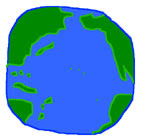
  Kolk, Melinda.  earthdrawn.jpg . Oct-00. Pics4Learning For a number of months now I have been taking groups of students on virtual tours to all corners of the world, and beyond! We have been learning about different countries, increasing vocabulary, improving  communication and cooperation skills and growing in autonomy. In this lesson, I wanted the learners to reflect that, although enriching, there is always an environmental price to pay when travelling. Like many others, I have recently been commenting on the continued patchy cover of environmental issues in tefl materials. As well as this, I have noticed that interest in this topic is not continued over time by many teachers. They will address some small aspect of the environment in one or two lessons, then that's it! There also seems to be a general lack of ideas about how to incorporate resources into interesting and motivating lessons. I feel that it is important to do what you can to remedy this – no matter ho...

Virtual tour of The Louvre, to view the Mona Lisa

Image
Photo by Free Birds on Unsplash If you have students who are interested in art and culture, this is the perfect virtual tour for them! It is suitable for all, as the resources I made are all easily adaptable for all levels. As always, these virtual tours have a strong focus on learner autonomy and group participation and communication. In particular, this session will help the students to develop listening skills in a variety of ways. They will use Total Physical Response (TPR), Higher Order Thinking Skills (HOTS), and collaborative and cooperative learning throughout. To lead in and create interest in the topic, I created a simple Zoom poll to get the group talking about art galleries in their countries. After this, they are asked for their ideas about the location of the virtual tour. I elicited that it was France and that it was The Louvre and one of the students was able to guess the Mona Lisa.  The students then take part in a sensory activity, designed to stimulate the...

How to take your students on a virtual African Safari

Image
  Photo by >>> niedblog.de on Unsplash My latest virtual tour is to the world-renowned Kruger National Park in South Africa. It became South Africa’s first national park in 1926 and is the largest game reserve in the country. Kruger National Park is reportedly home to 500 species of birds, as well as 100 reptiles and almost 150 mammals. In addition to taking a 4x4 safari   with the ranger, which is what we do on the virtual tour, visitors can take take a bush walk or view the park from a hot air balloon. This session has a strong focus on learner autonomy running throughout all the activities.   We use peer teaching for vocabulary building,   a KWL graphic organizer to allow the students to take more control over their own learning and track their own progress and to decide if they have met their objectives, a quiz where the students are in charge of the questions, and finally we use an activity based on Twitter to allow for self-reflection. To activate...

De Bono's Six Hats as a tool to respond to texts

Image
Edward de Bono’s Thinking Hats is a tool that is used by individuals and groups, often in business- in industries such as finance, healthcare and manufacturing- for problem solving and brainstorming. It has recently been used in online teacher training. See here for an interesting article on training physical education teachers. It can also be used in the classroom to develop the students’ skills of analyzing things from different perspectives, as well as to develop their critical thinking. It additionally promotes inclusivity and ensures that all participants are actively engaged in group work. In case the technique is new to you, basically it involves six hats – blue, green, red, yellow, black , white- and this allows for a group of people to explore a problem from a range of perspectives instead of looking at it from a narrower point of view only. Each hat represents one particular way of thinking (blue = process, green = creative, red = feelings, yellow = benefits, black = cau...